
Albemarle Deed Records by Instrument
The Circuit Court Clerk records land transfers for the jurisdiction where the land sits. Albemarle deed records stay local. They are filed with the office that serves the county itself. The index covers more than sales, too. It tracks instruments that create, change, or release interests in a parcel. Read the instrument's name and its terms before assuming anything. A deed conveys an interest. A deed of trust or lien only records a claim tied to the land.
| Deed Type | What It Does | Common Use |
|---|---|---|
| Deed or conveyance | Transfers a described land interest | Sale, gift or estate transfer |
| Deed of trust | Records a security interest related to a loan | Financing instrument |
| Certificate of satisfaction | Records release of a deed of trust | Payoff and release trail |
| Assignment | Moves an indexed interest to another party | Follow a later instrument |
| Plat or boundary agreement | Records lot geometry or boundary terms | Subdivision or boundary review |
The Albemarle index reaches further than deeds alone. Lis pendens, judgments, mechanic's liens, releases, easements, correction deeds, powers of attorney affecting land, trustee or sheriff sale instruments, conservation documents, and plats all appear there. Each entry tells you what to examine next. None of them alone says whether a claim against the parcel is still active. Match the document to the same property, then read any later release before drawing conclusions.
Albemarle SRA Index and Images
Virginia Secure Remote Access is also called SRA or COVERS. It is the remote layer for land records across the state. Statewide guidance says index-only access may be free where a clerk has enabled it. Images are different. They require a subscription the individual clerk authorizes, plus a signed agreement and payment. The accessible Albemarle page does not state a current online cutoff. It does not publish the live local search fields either.
The index may find an instrument. The image can still stay out of reach. Use a counter terminal or request a copy from the Circuit Clerk. Ask the Clerk for current per-page and certified-copy fees before sending anything. A search result is only a pointer. The filed document and any later release are the real evidence.
The Virginia SRA access page explains why a result and an image can carry different access rules. The same page illustrates that index-versus-image distinction for Albemarle deed records.
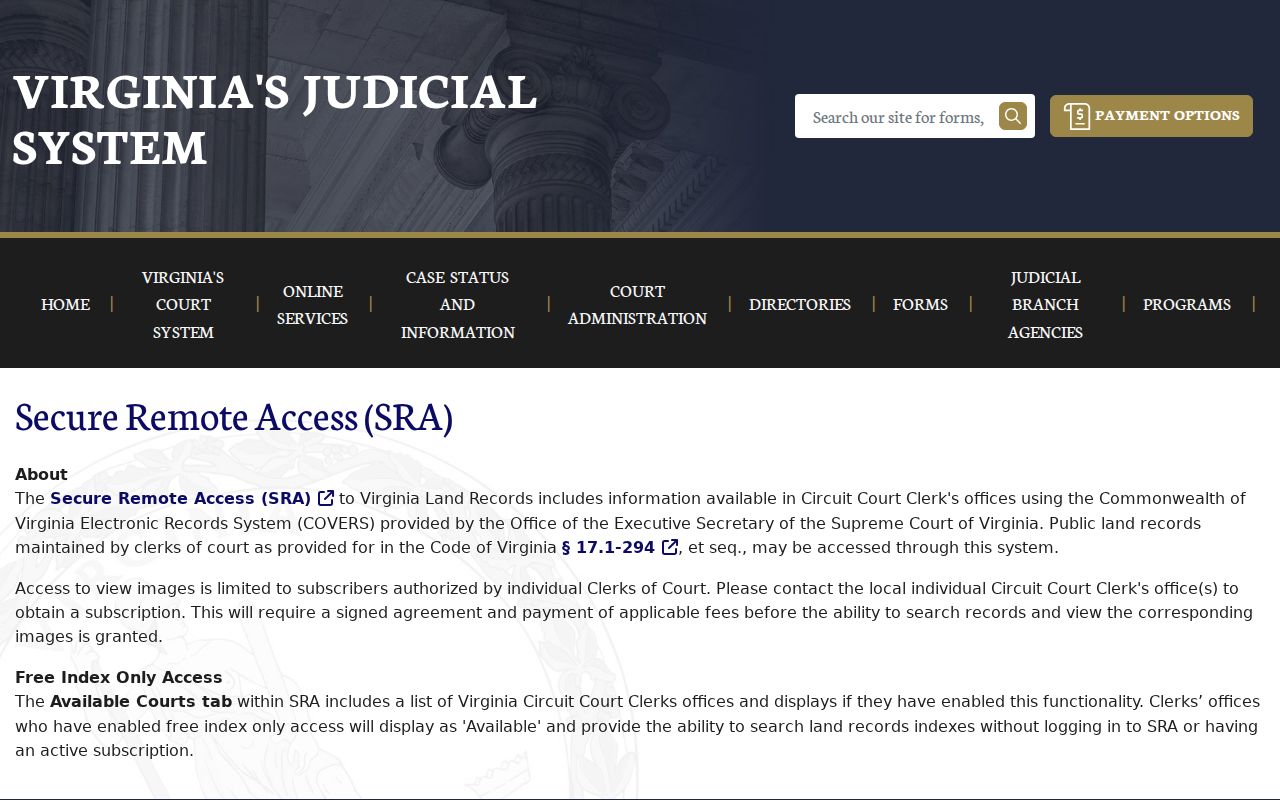
When the remote result stops short of the image, the Clerk's counter or copy route finishes the job.
Fields for an Albemarle Deed Search
The statewide SRA page describes access levels in general terms. It does not publish Albemarle's live form or its field labels. The search keys below are the standard ones for locating an instrument. Menu options, sort order, and any result cap can vary, so follow the county Clerk's guidance whenever the portal presents a different field set.
| Search clue | How it helps | Limit |
|---|---|---|
| Grantor / party name | Finds a party transferring an interest | Try spelling, initials and entity variants |
| Grantee / party name | Finds a party receiving an interest | Use the recorded name form |
| Instrument type | Narrows deeds, liens, releases or plats | Full local option list not published |
| Date or year | Limits a likely transfer period | Exact SRA date fields not verified |
| Book/page or document number | Confirms a known reference | Not every older source uses one format |
Follow Albemarle's Grantor-Grantee Trail
A grantor conveys an interest. A grantee receives it. To trace a deed chain in Albemarle, start with the newest instrument and verify its legal description against the parcel. The prior owner named as grantor then becomes a likely grantee in the earlier deed. Repeat that step backward, checking the parcel description and the book/page or document reference each time. A similar name alone never proves the same tract.
- Find the latest conveyance and confirm the parcel by its legal description.
- Read the current grantee and the grantor who conveyed the interest.
- Search the prior grantor as an earlier grantee, allowing for name variants.
- Repeat while comparing descriptions and instrument references at each transfer.
- For older material, use the Library of Virginia catalog and ask about microfilm or Clerk access.
- Grantor
- The party conveying a recorded interest.
- Grantee
- The party receiving that interest in the instrument.
- Chain of title
- The linked sequence of recorded transfers for a parcel.
- Book and page
- A volume-and-page reference used in historic records and local citations.
Albemarle Deed Books Reach Back Early
Albemarle deed books reach back to the county's earliest years. The Library of Virginia catalog lists a General Index to Deeds beginning with 1748-1819, followed by volumes covering 1820-1859, 1860-1884, 1885-1899, 1900-1909, and 1910-1917. The deed-book sequence runs from No. 2, dated 1758-1761, through No. 164 for 1916-1917. Deed Book No. 1 is cross-referenced to Wills and Deeds No. 1, 1748-1752, so an early search may require the combined catalog title rather than a modern book label. The Library's finding aid lists reels and interlibrary-loan indicators. Identify the volume and index span first, then ask about reference or loan access. For current recorded copies, the Clerk remains the office to contact. The Library of Virginia catalog shows the full Albemarle deed-index and deed-book spans.
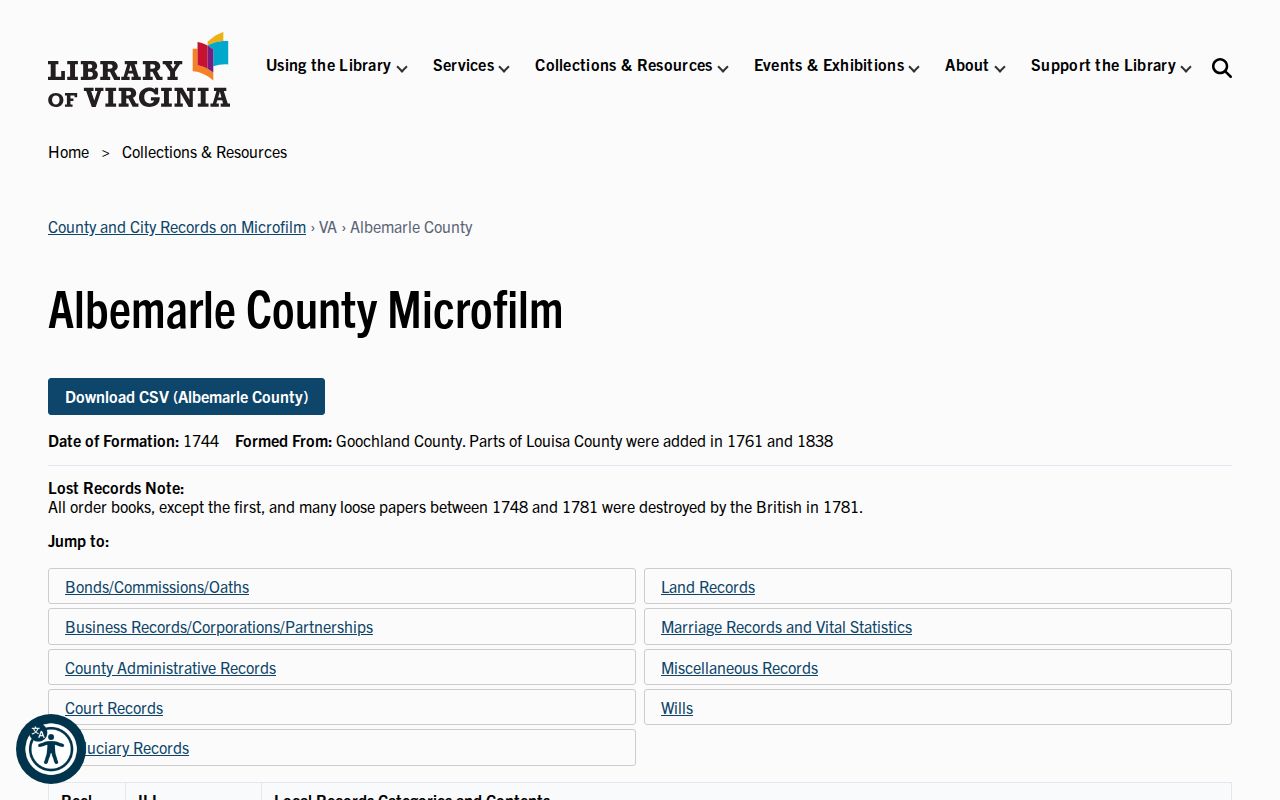
Volume and year coverage help direct a search when a current owner of record leads back into the historic books.
Albemarle Instruments Need a Cover Page
The Clerk requires a cover page with any instrument or deed submitted for recording. That filing rule is separate from how a reader searches for an already recorded document. When you request a copy, give the office the parties' names and the recording reference. Include the instrument type or legal description if known. Confirm the current copy fee and accepted request method directly with the office. Albemarle land records hold more than deeds. Correction deeds, powers of attorney affecting land, and trustee and sheriff sale instruments all appear in the records. So do boundary agreements, open-space instruments, and indexed UCC or fixture material. Military discharges carry separate confidentiality limits. The general Clerk office also keeps court and estate records. But the land index is the starting point for anything tied to a parcel.
Albemarle Chancery Adds Case Context
Not every Albemarle County deed chain ends in a tidy transfer. Some land disputes landed in chancery court instead. Albemarle chancery causes span 1768 through 1969. Digital images cover 1768 to 1871. A chancery file can hold a partition action. It may also hold a title defect, a boundary fight, estate land, or evidence tied to a sale. That explains why a parcel changed hands or why a deed description drifted. The recorded conveyance in the land records is still the document to check. Track down a cause through the Library's availability list first. Then follow whatever access details it gives. A scanned historic case may sit online. Later or undigitized material takes a reference request.
The Library of Virginia's finding aid lists Albemarle's chancery year range and scan span.
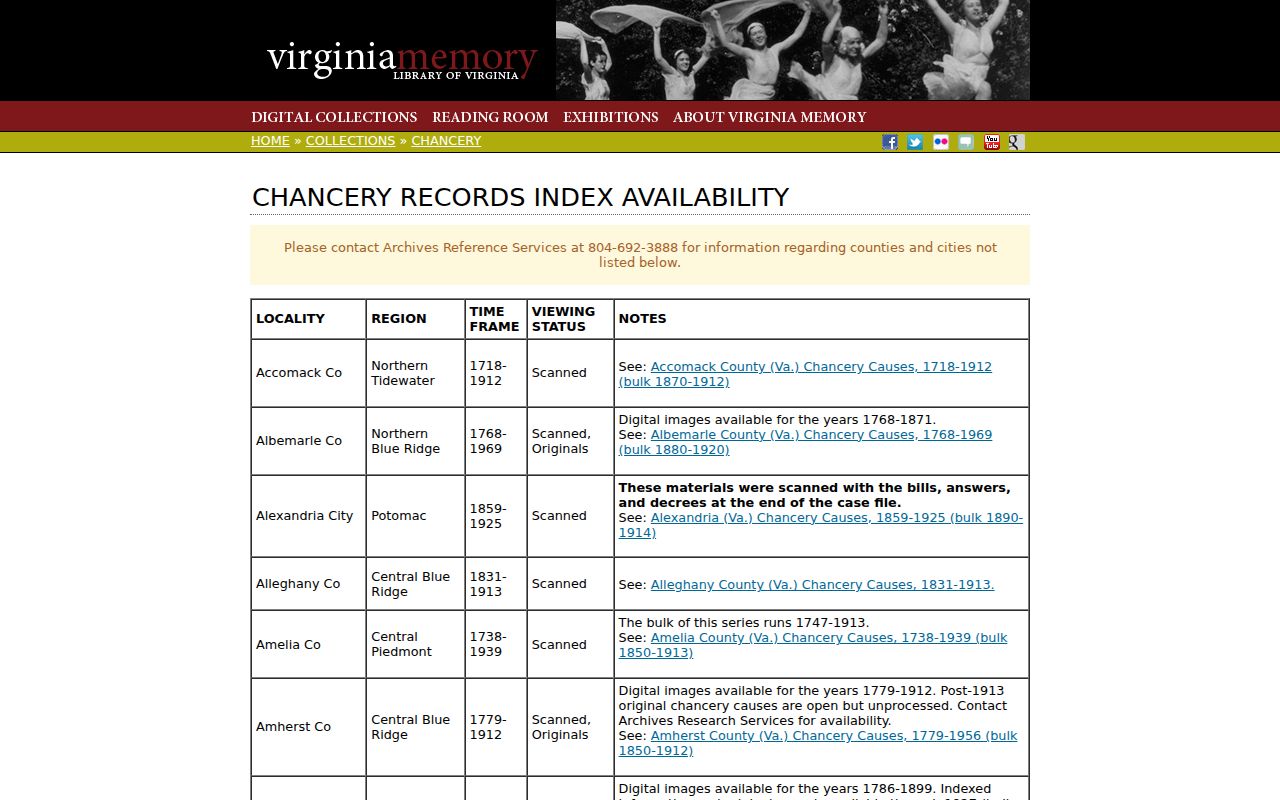
Treat a chancery reference as a lead. It adds case context, but the deed or plat still controls the parcel record.
Separate Deeds from Recorded Claims
A deed conveys an interest. A deed of trust records a security instrument. A certificate of satisfaction or release matters too. An old loan instrument can linger in the record books after the debt is paid. Assignments reveal a later party holding an interest. Lis pendens, judgments, mechanic's liens, easements, and boundary agreements can all shape what a property search should cover next.
For each result, note the document type, date, parties, and reference. Then hunt for a later release or correction. Compare the legal description against the parcel. Albemarle County GIS flags for easements and Agricultural/Forestal Districts offer useful clues. The county cautions that some mapped areas cover an entire parcel when only part is affected. The recorded instrument governs its own terms.
Request an Albemarle Deed Copy
The Land Records Division of the Albemarle County Circuit Court Clerk handles deed copy requests. The counter sits at 350 Park Street, Court Square, Charlottesville, VA 22902. Call 434-972-4083 during office hours, which run 8:00 a.m. to 4:00 p.m. The official land-record page lists current contact instructions. Remote SRA images are only an option when the Clerk has authorized the subscription. Otherwise, plan on a counter terminal or a direct copy request.
Give the Clerk enough detail to single out the instrument. Grantor and grantee names help. So does an approximate recording period. A parcel or legal description helps too. So does a book/page or document number if you have one. Albemarle's current per-page, certification, plat, and subscription charges are not published. Ask about fees before ordering a certified copy. Keep in mind that certification is not the same as a title opinion.
Recorded, not guaranteed. The Albemarle index shows instruments on file, not every possible interest or an assurance of clear title. Review the deed chain and obtain professional title work for a transaction.
Match an Albemarle Deed to the Parcel Description
Matching a grantor to a grantee is only the start. That step alone does not finish an Albemarle County deed search. Read the instrument's legal description, prior-book reference, acreage or lot language, and any attached plat reference. Judge from those details whether it touches the parcel in question. A shared owner name can point to a different tract. A similar street address can mislead the same way. This happens often where a parcel was divided or assembled over time.
Pull the current Parcel ID and Tax Map Parcel from County View. Compare those keys against the deed's lot, block, subdivision, or metes-and-bounds text. County GIS serves as an index aid only. Its polygon may not track the surveyed boundary. When a deed cites a plat, order or inspect that recorded plat through the Clerk. Read the instrument and the plat together.
Split a multi-tract transfer into its parts. Follow each description separately and mark which one maps to the present parcel. A title examiner may need further releases, deeds of trust, satisfactions, easements, or court orders. The latest deed alone does not settle every current encumbrance or resolve a boundary question.